
How California's local battery storage fights made the fleet bigger and safer.
Over the last five years, California has developed a self-reinforcing cycle around utility-scale battery storage:
- high-profile incidents trigger local moratoria and bans;
- moratoria push developers toward the state's AB 205 opt-in certification pathway, which strips local permitting authority but also enforces higher standards;
- developers invoking AB 205 for unrelated requirements provoke further local distrust, plus a few more incidents;
- in response, more sophisticated local regulation and higher statewide safety standards that gradually raise the floor for everyone.
The net result is not a slowdown in deployment - California's fleet grew from under 700 MW in 2019 to 21,112 MW by August 2026 [1] - but increasing pressure toward industry safety improvements from the state, driven by local concern. City of Industry, Covina, Solano County/Corby, and San Jose are the current edge of that five-year dynamic.
How did we get here? First, some history
1. Policy to support BESS deployment
In June 2022, the California legislature created the mechanism to increase and support BESS deployment for cleaner energy infrastructure: AB 205's Opt-In Certification Program. The program allows clean energy projects (BESS ≥200 MWh) to seek a consolidated permit directly from the California Energy Commission, in lieu of any local permit or ordinance, assuming specific safety measures are demonstrated and met [3].
AB 205 was an energy budget trailer bill aimed at the permitting bottlenecks slowing the SB 100 clean-energy buildout. The technology was deploying faster than local codes could absorb it - most municipal codes simply had no definition of a BESS, leaving projects to be permitted as generic "utility" or "industrial" uses. And that worked well until incidents created local concern.
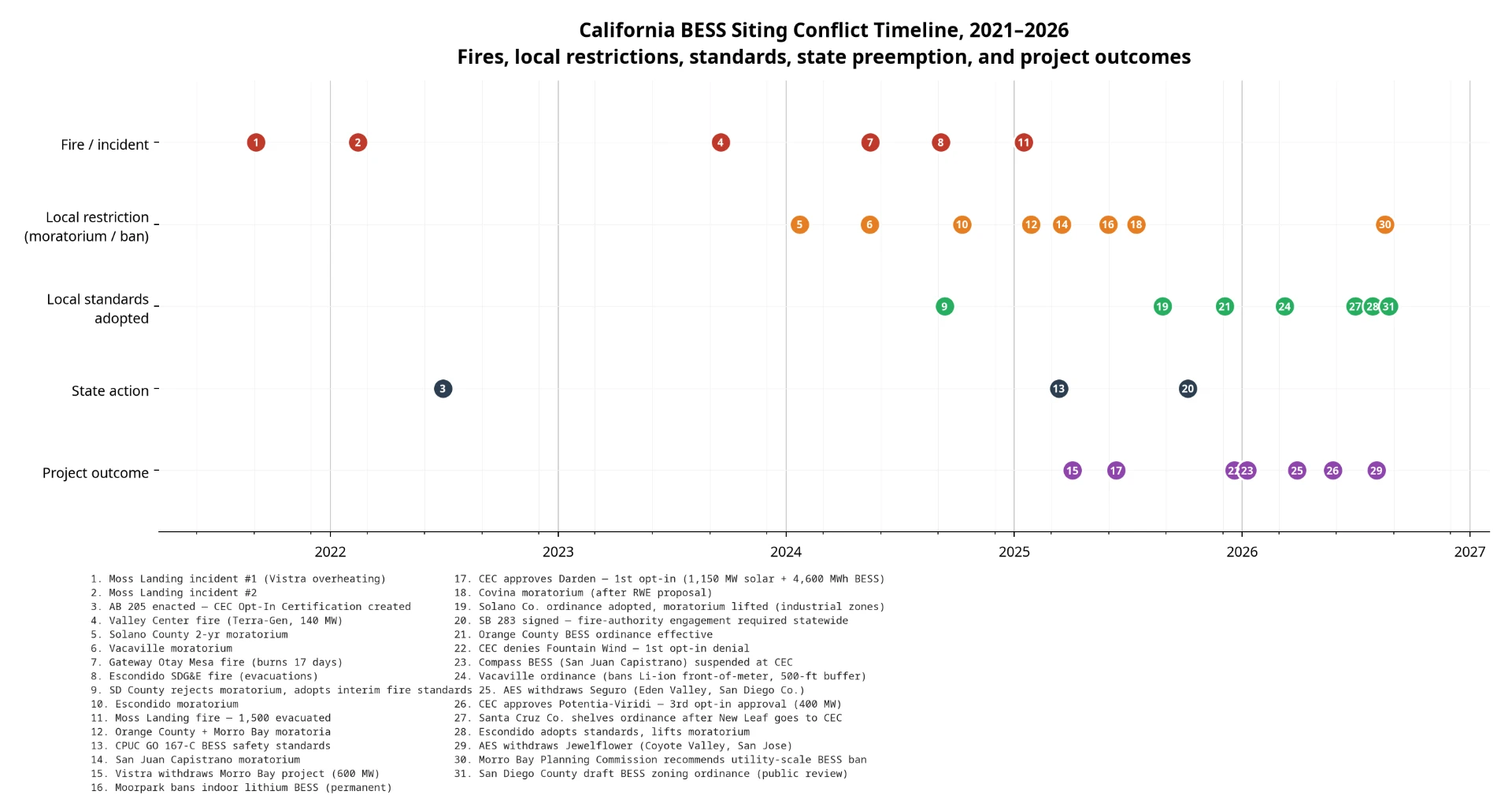
2. The fire-driven policy wave begins
Before AB 205, the Moss Landing facility - then the world's largest BESS - suffered overheating incidents in September 2021 and February 2022, both traced to malfunctions in its water-based heat suppression system [2]. These were treated at the time as technical teething problems rather than land-use issues, and they produced no local restrictions.
The first real local flashpoint came in September 2023, when a fire at Terra-Gen's 140 MW Valley Center facility in San Diego's backcountry put BESS fire risk on the radar of rural San Diego County communities [4]. Through 2023, however, not a single California jurisdiction had a BESS moratorium.
Then three fires in sixteen months converted latent unease into policy. The Gateway fire in Otay Mesa (May 15, 2024) burned with periodic flare-ups for roughly two weeks [5]; the Escondido SDG&E fire (September 5, 2024) forced evacuations of nearby schools and businesses [6]; and the Valley Center incident was still fresh in the same county. The local response came in two distinct forms that would define the next two years:
| Response model | First mover | What happened |
|---|---|---|
| Moratorium-then-standards | Solano County | Enacted a two-year pause on front-of-the-meter BESS in January 2024 - California's first county-level BESS moratorium - explicitly to buy time to write safety-focused land-use standards [7] |
| Standards-without-moratorium | San Diego County | In July 2024 the Board of Supervisors directed staff to create BESS rules; in September 2024 it unanimously rejected a countywide moratorium and instead adopted interim fire-safety guidelines (100-ft setbacks, large-scale fire testing, hazard mitigation and plume modeling) [8] [9] |
Vacaville followed Solano with its own moratorium in May 2024 [10], and Escondido became the first city in San Diego County to impose one in October 2024 [11]. Notably, this first wave was still a standards conversation: every jurisdiction that paused said it was doing so to write rules, not to keep the technology out permanently.
3. Moss Landing upends the norm
The January 16, 2025 fire at Vistra's Moss 300 facility - the third and most severe failure at that site - burned for days, forced the evacuation of roughly 1,200–1,500 residents, and became the largest lithium-ion battery cleanup in EPA history [12] [13]. Its political effect was immediate and durable, because it validated the worst-case narrative (a fire at the world's most scrutinized facility, in a coastal community, with toxic smoke) rather than a marginal one. Within four months:
- Orange County (January 28) and Morro Bay (January 28) enacted moratoria [14] [15];
- San Juan Capistrano followed in March, responding to the proposed 250 MW Compass project [14];
- Vistra withdrew its 600 MW Morro Bay project in April 2025 after a citizen campaign - the first major California BESS cancellation driven purely by local opposition [16];
- Moorpark went furthest, voting unanimously in May 2025 to permanently ban indoor lithium BESS in its industrial zones - the state's first permanent BESS prohibition [17].
Moss Landing also changed the content of the debate. Opposition broadened from fire risk to toxic plume exposure, heavy-metal contamination, and evacuation capacity - concerns that setback distances alone cannot fully answer, which is what pushed some communities from "regulate" toward "prohibit." And because the 2024–2025 fires made local permitting hostile, the industry started using AB 205's dormant bypass as an escape valve.
4. California legislation requires improvements, but doesn't remove AB 205
The state's response to the post-Moss Landing backlash was to professionalize safety oversight while simultaneously keeping the deployment throttle open:
- CPUC General Order 167-C (March 2025) imposed new safety standards, emergency response plan requirements, and audit authority over BESS facilities [18];
- California Fire Code updates incorporating enhanced BESS standards (aligned with NFPA 855) took effect January 1, 2026 [19];
- SB 283, the Clean Energy Safety Act of 2025 (signed October 6, 2025; effective January 1, 2026), declared BESS safety a matter of statewide concern and requires developers to engage local fire authorities on design, risk assessment, and emergency response before filing applications - applying to both local and CEC pathways [20].
Meanwhile, the legislature rejected the two bills that would have gutted the opt-in pathway - AB 303 (Addis), which would have removed BESS from CEC jurisdiction and imposed 3,200-foot setbacks, and AB 434 (DeMaio), which would have frozen all BESS permitting until 2028. Both died as two-year bills in June 2025 [21]. The signal to local governments was unmistakable: the state will raise safety standards, but it will not hand siting authority back.
Local governments, in turn, split into two camps:
Camp A - "Regulate." Solano County lifted its moratorium in August 2025 with an ordinance channeling BESS into industrial zones [22]; Orange County's ordinance took effect December 4, 2025 with 100-foot residential setbacks [23]; Vacaville adopted its ordinance in March 2026 - notable for banning lithium-ion chemistry outright for front-of-the-meter projects and imposing a 500-foot buffer [24]; Escondido lifted its moratorium July 29, 2026 with the San Diego County-style package (100-ft setbacks, suppression, plume analysis) [25]; and San Diego County's comprehensive tiered zoning ordinance entered public review in August 2026 [26].
The primary driver in each case was the incident record. These packages are direct answers to Gateway, Escondido, and Moss Landing. But the AB 205 backdrop clearly shaped timing and form: Solano planners and Central Coast Community Energy (in Morro Bay) both said explicitly that a workable local ordinance is the only way to keep projects out of the CEC's hands [22] [15], and jurisdictions deliberately calibrated their rules to be strict enough to address fire risk yet permissive enough that developers would not abandon the local process. Preemption here acted as a disciplining constraint on regulation, not as the reason for it.
Camp B - "Prohibit." Moorpark's permanent zoning ban (May 2025), Morro Bay's Planning Commission recommendation to ban front-of-the-meter BESS (August 18, 2026), and Monterey County's post-Moss Landing push toward a moratorium and restrictive ordinance [27] represent the camp where trust in the technology itself has collapsed. The proximate cause in every case is a specific incident or project - Moss Landing for Monterey County, the Vistra proposal for Morro Bay, and indoor-facility fire risk for Moorpark. Preemption enters only as a secondary grievance: the knowledge that a ban may simply reroute a developer to the CEC deepens local frustration. And, as Santa Cruz County's experience shows, it can turn safety opposition into procedural opposition once a developer actually jumps.
The safety valve becomes the main channel
The single most important structural development of the period is the maturation of the AB 205 Opt-In Certification Program from a theoretical bypass into the industry's standard playbook for contested sites:
| CEC opt-in milestone | Date | Significance |
|---|---|---|
| Darden Clean Energy Project approved (Fresno Co.; 1,150 MW solar + 1,150 MW/4,600 MWh BESS) | June 2025 | First project ever certified under opt-in; world's largest solar-plus-storage approval [28] |
| Fountain Wind denied (Shasta Co.) | December 2025 | First opt-in denial - proved the CEC is not a rubber stamp, which paradoxically strengthened the program's legitimacy [29] |
| Compass Energy Storage (San Juan Capistrano) suspended | December 2025–January 2026 | Developer pulled back after sustained local opposition and Sierra Club pressure even at the state level [30] |
| Soda Mountain Solar approved (San Bernardino Co.; 300 MW solar + 300 MW BESS) | April 2026 | Second approval [31] |
| Potentia-Viridi BESS approved (Alameda Co.; 400 MW/3,200 MWh) | May 26, 2026 | Third approval; ~3,300 MW certified in the program's first year [31] |
| Seahawk BESS (New Leaf Energy, Watsonville) filed | June 2026 | Developer abandoned a pending county application mid-process to go to the CEC - prompting Santa Cruz County to shelve its two-year ordinance effort entirely [32] |
| Corby BESS (300 MW, Solano Co.) in review | Hearing Aug. 31, 2026 | Opt-in being used to site in a county whose own ordinance channels BESS to industrial zones [33] |
The queue now stands at roughly a dozen projects (Compass, Corby, Darden, Fountain Wind, Perkins, Potentia-Viridi, Prairie Song, Seahawk, Soda Mountain, Vaca Dixon, Viracocha-Hill) [3]. The Santa Cruz episode is the clearest illustration of the endgame dynamic: once a developer opts into the CEC, the local ordinance becomes a comment letter. Santa Cruz County's staff concluded that finishing their two-year ordinance was no longer worth $500,000 of environmental review, and the Board shelved it unanimously - while pointedly forwarding the draft to the CEC as a "blueprint" of local expectations [32].
So. Where do we stand?
Measured by deployment, BESS has taken its hits and kept growing. California's fleet grew from ~700 MW (early 2019) to 15.7 GW (May 2025) to 21,112 MW (August 2026) - a 2,500%+ increase in seven and a half years, against a state planning target of 52,000 MW by 2045 [1] [34]. Arevon's 300 MW Nighthawk project in Poway - the first new BESS to open in the San Diego region after the fire-driven rule changes - began operations in August 2026 under the stricter regime [35].
Measured by project attrition, however, local opposition is also scoring real wins: Vistra/Morro Bay (600 MW), AES/Seguro (320 MW-class, Eden Valley), AES/Jewelflower (Coyote Valley), and Compass/San Juan Capistrano (250 MW) were all withdrawn or suspended in a 16-month span, and the City of Industry's 400 MW Marici approval (January 2026) remains tied up in CEQA litigation [16] [36] [37] [30] [38]. The pattern in those losses is consistent: projects sited close to homes, schools, or in high-fire-risk wildland-urban interface are the ones dying; projects in industrial zones or remote agricultural land (Darden, Potentia-Viridi, Nighthawk) are getting built.
Two further nuances matter for reading the trend. First, the objective safety record is improving even as restrictions multiply: EPRI's failure-incident database shows the global grid-scale BESS failure rate fell ~97–99% between 2018 and 2025, to an all-time low of 0.03 fires per GWh in 2025, as designs incorporated earlier lessons and requirements [39] [42]. The moratorium wave is therefore driven less by the current incident rate than by the salience of a handful of catastrophic 2024–2025 events - a classic risk-perception gap that policy is still catching up to.
Second, California's restriction count is actually modest by national standards: about 4–6 active restrictions versus 97 in New York and 150+ nationwide [14] [40]. California's distinctiveness is not the volume of bans but the existence of a credible state bypass, which changes every local negotiation.
Where the trend is heading
Five expectations follow from the five-year arc:
- The moratorium era is maturing into an ordinance era. Nearly every early moratorium (Solano, Orange County, Vacaville, Escondido) has now converted into permanent standards; San Diego County and Monterey County will complete theirs by 2027. Expect the "San Diego template" - tiered permits, 100-ft+ setbacks, plume modeling, decommissioning bonds - to become the statewide baseline, with Vacaville-style chemistry restrictions as the more aggressive variant.
- The CEC opt-in will absorb the contested large projects. With three approvals, one denial, and a ~270-day statutory clock, the pathway is proven. Any project ≥200 MWh facing local resistance will now default to Sacramento, and local ordinances increasingly function as negotiating positions rather than vetoes - exactly as Central Coast Community Energy warned Morro Bay [15].
- Bans will cluster where a specific project traumatized the community (Moss Landing → Monterey County; Vistra → Morro Bay; Compass → San Juan Capistrano), but remain the minority outcome, because bans simply reroute developers to the CEC.
- The fight is migrating from "whether" to "where and what chemistry." Siting near sensitive receptors and lithium-ion chemistry in high-fire zones are the losing propositions; industrial-zone siting, newer chemistries, and immersion-cooled/non-propagating designs are becoming the de facto compliance answer - a dynamic technology vendors are already exploiting [24].
- Watch the data-center backlash as the accelerant. The same coalition mechanics (water, grid strain, industrial land use near homes) that produced August 2026's data-center bans in the Coachella Valley are now appearing in BESS hearings - Adelanto's planning commission rejected a zoning package covering both uses in the same vote [41]. As data centers and BESS increasingly co-locate, expect the two opposition movements to merge, and expect Sacramento's preemption ratchet (AB 205, SB 283, and any 2027 follow-ons) to keep tightening in response.
References
- California Energy Commission - California surpasses 21,000 megawatts of battery resources (Aug. 7, 2026)
- Moss Landing Response - Previous Incidents
- California Energy Commission - Opt-In Certification Program
- EPRI StorageWiki - Failure Event: US, CA, Valley Center, 18 Sep 2023
- US EPA - Gateway Energy Camino Lithium-Ion Battery Fire
- KPBS - Escondido adopts strict battery storage safety rules, ending city moratorium (Aug. 5, 2026)
- Solano County - Battery Energy Storage Systems
- Energy-Storage.News - California's San Diego County votes to adopt BESS standards following recent battery fires (July 25, 2024)
- California Energy Storage Alliance - San Diego County Board of Supervisors Rejects BESS Moratorium (Sept. 11, 2024)
- City of Vacaville - Battery Energy Storage Systems
- ESS News - Californian city introduces temporary moratorium on battery storage sites (Oct. 10, 2024)
- US EPA - Moss Landing Vistra Battery Fire Response
- US EPA - EPA Oversees Largest Lithium-Ion Battery Cleanup in Agency History (Sept. 29, 2025)
- Carina Energy - California BESS Moratoriums
- San Luis Obispo Tribune - SLO County beach town may ban utility-scale battery plants (Aug. 19, 2026)
- KSBY - Vistra withdraws BESS proposal from City of Morro Bay (Apr. 10, 2025)
- Moorpark Acorn - City Council bans indoor battery storage systems (July 2025)
- CPUC - CPUC Sets New Safety Standards and Enhances Oversight of Emergency Plans (Mar. 13, 2025)
- California Energy Commission - CEC Approves Third Major Clean Energy Project Under Opt-In Certification Program (May 26, 2026)
- Office of Sen. John Laird - Governor Newsom Signs Legislation to Enhance Battery Storage Safety (Oct. 2025)
- Allen Matkins - California Battery Energy Storage Update (June 23, 2025)
- Energy-Storage.News - California county adopts 'balanced' BESS zoning, hopes to stop developers seeking state-level approvals (Aug. 19, 2025)
- EticaAG - Orange County's BESS Ordinance Sets New Rules for Safe Energy Storage (Apr. 1, 2026)
- EticaAG - Vacaville Adopts New Battery Storage Ordinance After Two-Year Review (Mar. 16, 2026)
- NBC 7 San Diego - Escondido City Council passes battery energy storage center guidelines after fire (July 29, 2026)
- East County Magazine - County to present proposed battery storage rules in Campo Aug. 24 (Aug. 24, 2026)
- Monterey County - Battery Energy Storage Systems Ordinance (REF260006)
- POWER Magazine - 'World's Largest' Energy Storage Site Approved as Part of California Solar Project (June 13, 2025)
- KRCR - Shasta County celebrates CEC's rejection of controversial Fountain Wind Project (Dec. 19, 2025)
- Voice of OC - South OC Battery Storage Project Halted For Now (Jan. 21, 2026)
- California Energy Commission - CEC Approves Third Major Clean Energy Project Under Opt-In Certification Program (May 26, 2026)
- Lookout Santa Cruz - Supervisors shelve battery storage ordinance after Watsonville project moves to state (July 1, 2026)
- The Reporter - California Energy Commission to hold hearing on Corby BESS project (Aug. 31, 2026)
- California Energy Storage Alliance - California's Battery Boom Continues (May 20, 2025)
- Arevon - Arevon's 300 Megawatt Nighthawk Energy Storage Project is Operational in Poway (Aug. 12, 2026)
- The Coast News - Developer withdraws Seguro battery project in Eden Valley (Apr. 7, 2026)
- San Jose Inside - Virginia Firm Drops Plans for Huge Battery Plant in Coyote Valley (Aug. 4, 2026)
- LAist - SGV residents rally against battery storage hub in City of Industry (May 2026)
- EPRI - Battery Energy Storage System Failure Incident Database
- Energy-Storage.News - New York leads US in BESS moratoriums, recent data shows (Mar. 13, 2026)
- KVCR - Coachella becomes second California city to ban data centers as opposition swells in Golden State (Aug. 28, 2026)
- Science Feedback - Are grid battery storage systems fire-prone? Early data suggests their fires are rare (Dec. 2, 2025)